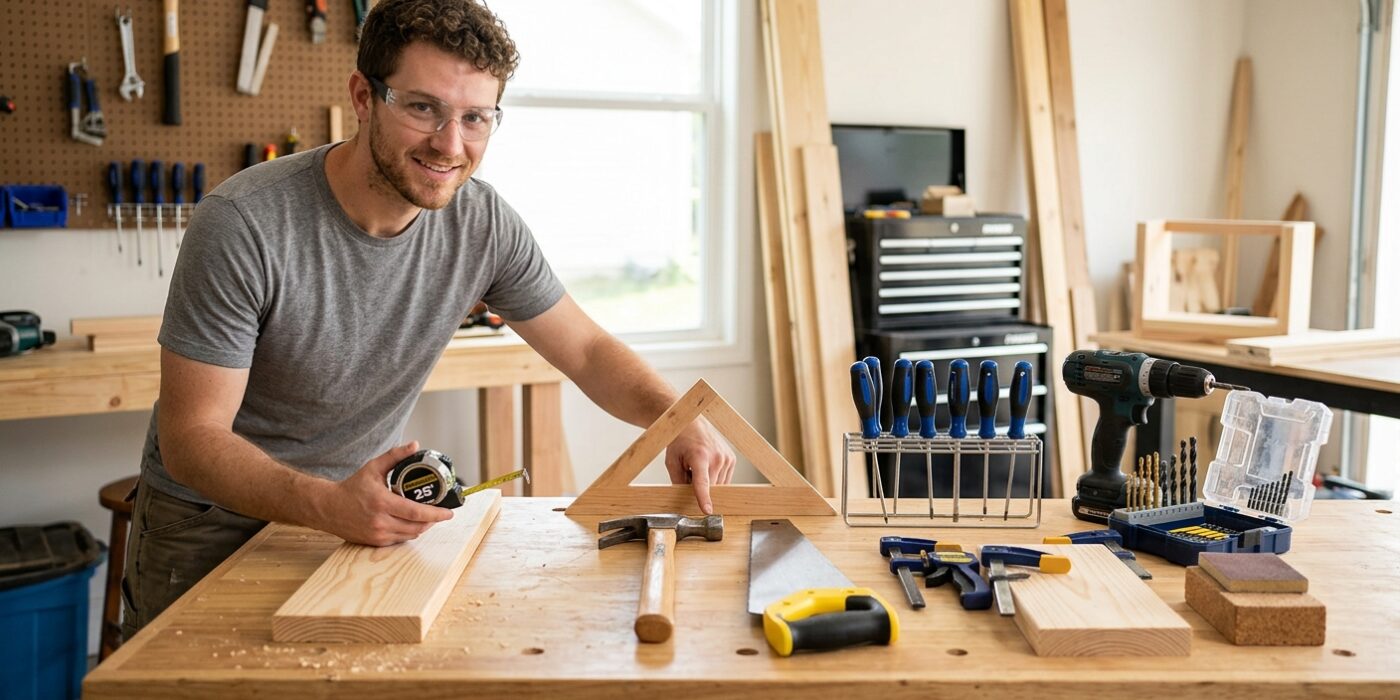
You don’t need a fully stocked shop to build beautiful things with wood. Most first projects – a workbench, shelving, a raised garden bed – require fewer than ten tools. This guide tells you which ones to buy first, what to spend, and where to find honest reviews before you commit.
The Essential Beginner Woodworking Toolkit
1. Cordless Drill / Driver
The single most important tool in any beginner’s kit. A good cordless drill drives screws, drills holes, and handles more tasks than any other tool. Look for an 18V or 20V brushless model – brushless motors run cooler, last longer, and have more torque for the money.
What to look for: Variable speed trigger, belt clip, two batteries in the kit, 1/2" chuck.
Price range: $80–$200 for a solid kit.
→ See our full roundup: Best Cordless Drills of 2026 – 8 Picks for Every Budget at DIY Arsenal.
2. Circular Saw
Sheet goods (plywood, OSB) don’t fit through most shop saws – a circular saw is how you break down 4×8 sheets on the floor or a pair of sawhorses. Combined with a straightedge guide, it makes cuts accurate enough for furniture.
What to look for: 7-1/4" blade, blade-left design for better sightlines, at least 15 amps (corded) or 18–20V brushless (cordless).
Price range: $60–$180.
→ See our full roundup: Best Circular Saws of 2026 – From Budget to Pro at DIY Arsenal.
3. Miter Saw
Once you start building frames, trim work, or anything with angled cuts, a miter saw becomes indispensable. A 10" sliding compound miter saw handles most lumber sizes and lets you cut boards to length with accuracy that hand sawing can’t match.
What to look for: 10" or 12" blade, sliding head for wide boards, positive stops at common angles (45°, 22.5°).
Price range: $150–$400.
→ See our full roundup: Best Miter Saws – Compound, Sliding, and Dual-Bevel Explained at DIY Arsenal.
4. Random Orbital Sander
Finishing is what separates a good project from a great one. A random orbital sander removes mill marks, smooths joints, and preps wood for stain or paint in a fraction of the time hand-sanding takes. The random orbit pattern leaves no swirl marks.
What to look for: 5" pad, variable speed, easy hook-and-loop disc change, dust collection port.
Price range: $35–$100.
→ See our full roundup: Best Random Orbital Sanders – Tested and Compared at DIY Arsenal.
5. Hammer
No tool kit is complete without a good claw hammer. Nailing, disassembly, adjusting joints – you’ll reach for it constantly. A 16 oz smooth-face hammer handles 95% of woodworking tasks without marring the wood surface like a waffle-face framing hammer.
What to look for: Fiberglass or wood handle, 16 oz head, smooth face, curved claw for pulling nails.
Price range: $20–$50.
→ See our full roundup: Best Hammers for Every DIY Task – Claw, Rip, and Framing at DIY Arsenal.
6. Wood Chisels (Set of 4)
Once you start mortise and tenon work, fitting door hinges, or cleaning up joints, a sharp set of chisels is essential. Buy a basic 4-piece set and learn to sharpen them – a sharp chisel is safer and more effective than a dull one.
What to look for: 1/4", 1/2", 3/4", 1" sizes, steel-capped handles for mallet use, included honing guide.
Price range: $25–$80.
→ See our full roundup: Best Wood Chisels for Beginner Woodworkers at DIY Arsenal.
7. Tape Measure & Speed Square
Measure twice, cut once. A 25-ft tape measure and a speed square for marking 90° and 45° cuts are the two measuring tools you’ll use on every single project.
Price range: $10–$25 for both.
→ See our guide: Measuring & Layout Tools at DIY Arsenal.
What to Build First
Ready to put those tools to work? Start with one of these beginner-friendly projects on Build This Project:
Frequently Asked Questions
Do I need a table saw as a beginner?
Not right away. A circular saw with a straightedge guide gets you 90% of what a table saw does for a fraction of the price and storage space. Add a table saw once you’re ripping a lot of solid lumber or doing serious furniture work.
Corded or cordless for a beginner?
Cordless is more versatile and the battery technology in 2026 makes it the right default choice for most beginners. The only exception is sanders and routers where corded still has an edge for sustained use.
What’s the most important safety tool for woodworking?
Eye protection, hearing protection, and a good dust mask – every time, even for short cuts. Fine wood dust is a respiratory hazard that accumulates over time. See our Safety & PPE roundups on DIY Arsenal.