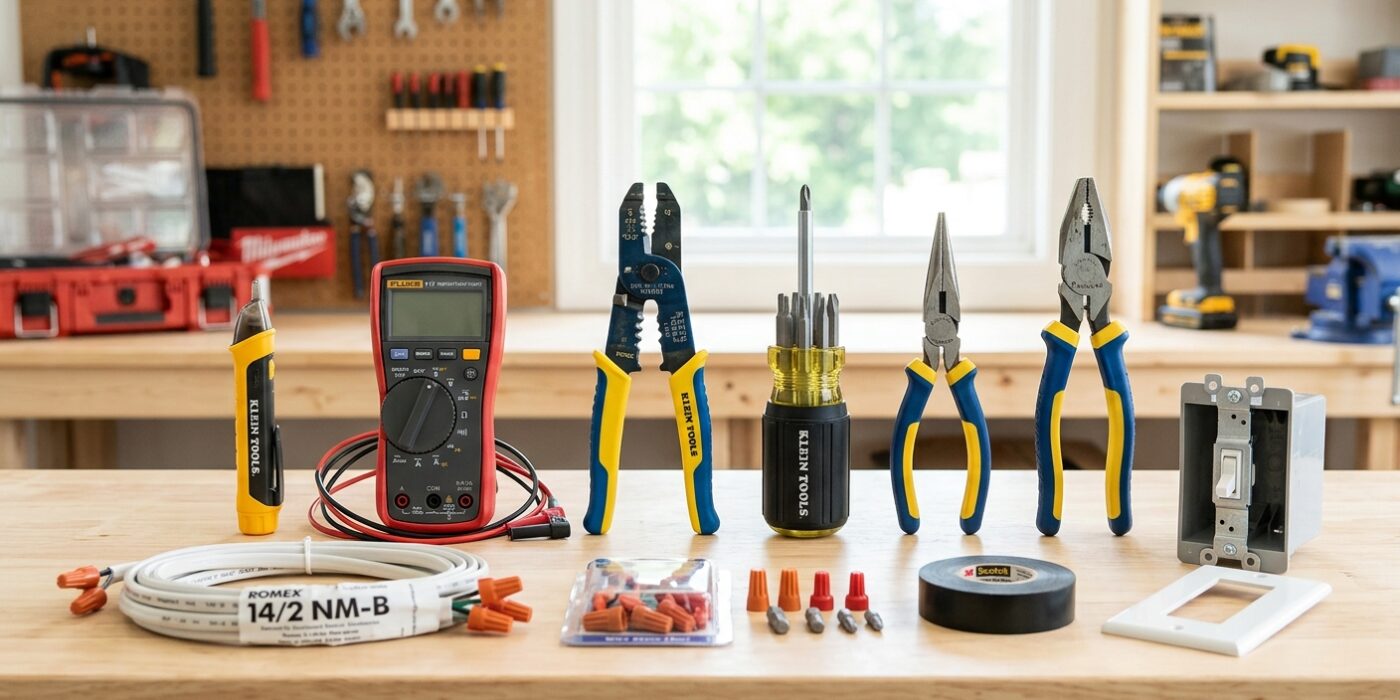
Basic electrical work – replacing outlets and switches, installing ceiling fans, adding GFCI protection, and running new circuits – is within reach for careful DIYers in most jurisdictions. The critical rule: always turn off the circuit at the breaker and verify it’s off before touching any wires.
Essential Electrical Tools for Homeowners
1. Non-Contact Voltage Tester
The single most important safety tool for any electrical work. A non-contact voltage tester detects live current through wire insulation without touching the conductor. Use it before touching any wire, every time. There is no exception to this rule.
What to look for: LED and audible alert, auto power-off, rated for 12–1000V AC.
Price range: $15–$30.
2. Multimeter
A multimeter measures voltage, current, and resistance – it’s the diagnostic tool for understanding what’s happening in a circuit. Use it to confirm a circuit is truly off, check outlet voltage, test continuity in switches, and troubleshoot wiring problems.
→ See our review: Best Continuity Testers and Circuit Analyzers at DIY Arsenal.
Price range: $20–$60 for a reliable unit.
3. Circuit Breaker Finder
Identifying which breaker controls which circuit is a frustrating process without the right tool. A circuit breaker finder plugs into an outlet and a receiver at the panel identifies the exact breaker. Invaluable for older homes with unlabeled panels.
→ See our review: Best Electrical Panel Breaker Finders and Circuit Tracers at DIY Arsenal.
Price range: $25–$60.
4. Wire Stripper / Crimper
For removing insulation from wire ends without nicking the conductor. A quality wire stripper with a self-adjusting jaw works on 10–24 AWG wire and removes insulation cleanly every time. Look for one with an integrated crimper for connector work.
Price range: $15–$35.
5. Electrical Fish Sticks
Running new wire through finished walls requires fishing it from one opening to another. Fiberglass fish sticks connect end-to-end and can push, pull, or navigate bends in a wall cavity.
→ See our review: Best Electrical Fish Sticks and Wire Fishing Tools at DIY Arsenal.
Price range: $20–$45 for a kit.
6. Wire Nuts + Electrical Tape
Wire nuts (twist-on connectors) join wires inside junction boxes. Keep a mixed pack of sizes on hand – small for 14 AWG and under, large for 12 AWG. Electrical tape is a backup for exposed conductors and for wrapping connections that might vibrate loose.
→ See our review: Best Wire Nuts and Crimp Connectors at DIY Arsenal.
Price range: $5–$12 per pack.
7. Needle-Nose Pliers
For making the J-hook on wire ends that loop under screw terminals, reaching into tight junction boxes, and holding small components. A 6" needle-nose with a side cutter is the right tool.
Price range: $10–$20.
8. Laser Level for Box Layout
When installing multiple outlets, switches, or boxes in a line, a laser level ensures everything is at consistent height – critical in new construction or large remodels.
→ See our review: Best Laser Level for Electrical Box and Outlet Layout at DIY Arsenal.
Start Your Project
Frequently Asked Questions
Do I need a permit for electrical work?
It depends on your jurisdiction and the scope of work. Simple replacements (outlet, switch, light fixture) generally don’t require permits. New circuits, panel work, and service upgrades almost always do. Check with your local building department – the permit fee is small compared to the liability of unpermitted work discovered at sale.
What’s the most dangerous mistake in DIY electrical?
Working on a live circuit. Always verify the circuit is off with a non-contact tester – breaker labels are often wrong, and some circuits feed from multiple breakers. Test before you touch, every single time.
Can I add outlets to an existing circuit?
Usually yes, if the circuit has enough capacity. Most bedroom and living area circuits are 15A (using 14 AWG wire). You can add outlets as long as the total load on the circuit stays within 80% of the breaker rating – roughly 12A of continuous load on a 15A breaker. See our electrical guides for step-by-step instructions.