Project Shopping List
Drywall finishing levels are a standardized system (Level 0 through Level 5) that defines how much work is required before a surface is considered ready for its intended use or paint. Specifying and understanding finish levels prevents miscommunication between contractors and homeowners, and helps you know what to expect from your own DIY work at each stage.
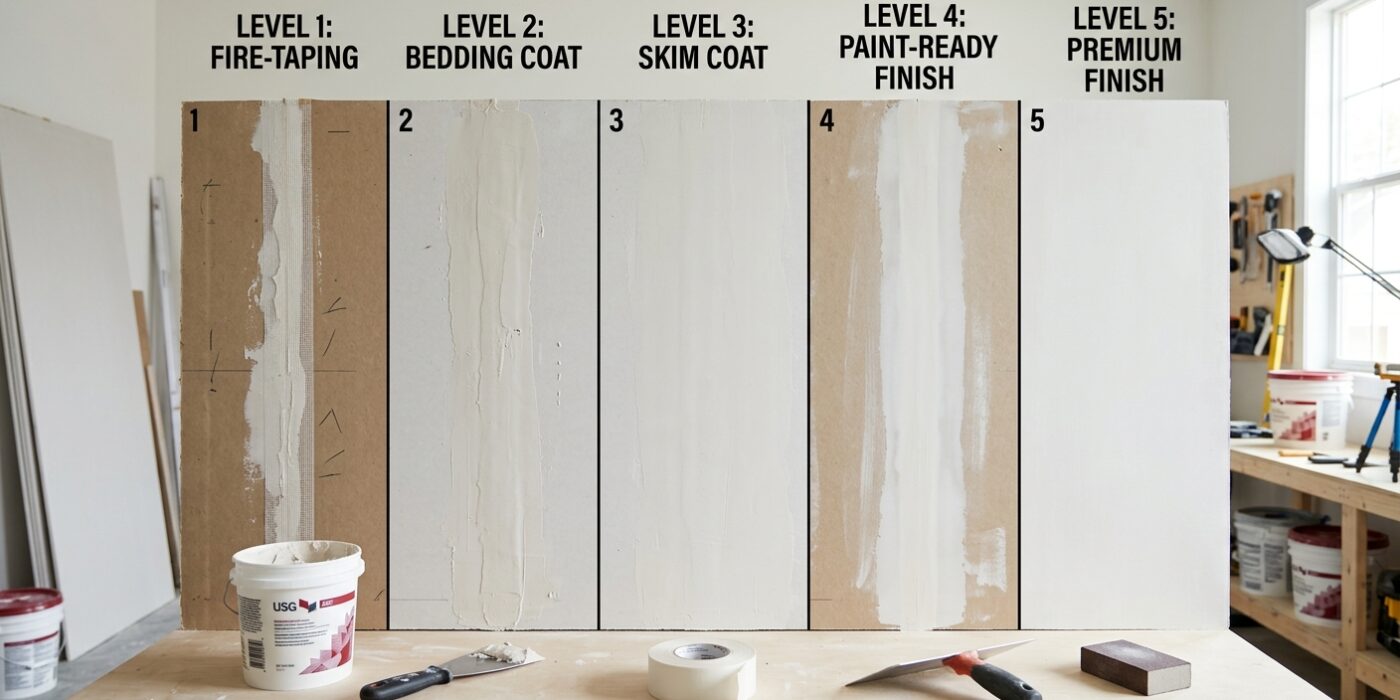
The Five Drywall Finish Levels
Level 0: No Finish
No taping, finishing, or accessories required. Used for temporary construction or areas where final finish level has not yet been determined. Never used as a final finish for any occupied space.
Level 1: Tape Embedded in Compound Only
Tape is applied to all joints and interior angles with a joint compound embedding coat. Excess compound is not smoothed further. Tool marks, ridges, and lap marks are acceptable. Level 1 is used in areas not visible in the finished building — above suspended ceilings, in attic spaces, and in service corridors. It is not acceptable for any living space.
Level 2: Tape Plus One Coat Over Tape and Fasteners
Tape is embedded in compound, and one additional coat covers all tape, angles, fastener heads, and accessories. Surface is still rough and not ready for paint. Level 2 is used in garages, warehouse spaces, and anywhere that will receive a heavy applied texture (skip trowel, knockdown) that is thick enough to hide the underlying surface imperfections. Also acceptable for areas that will be tiled, as tile adhesive provides its own substrate.
Level 3: Tape Plus Two Coats
All joints, angles, fasteners, and beads receive an embedding coat plus two additional coats of compound. Compound is smooth, uniform, and ready for heavy-duty wall texture applied by spray or trowel. Level 3 is not suitable for flat or eggshell paint applied directly without texture — the joint seams will telegraph through the paint. It is appropriate when a medium to heavy texture will cover the surface, or for commercial spaces with heavy aggregate paint.
Level 4: Standard Finish for Most Residential Walls
All joints, angles, fasteners, and beads receive an embedding coat plus three additional coats, each wider than the last. The surface is smooth enough for flat, eggshell, satin, or light semi-gloss paint. Level 4 is the standard specification for residential walls and ceilings in most contracts. However, Level 4 is not adequate for walls that will receive a single coat of high-gloss paint in strong side lighting — any remaining imperfections will be visible.
Level 5: Premium Finish for Gloss Paint or Critical Lighting
Level 4 finish plus a skim coat of joint compound over the entire surface. The skim coat hides any remaining texture differences between the compound and the drywall paper face, produces a perfectly uniform surface, and is mandatory for walls that will receive semi-gloss or gloss paint, or any surface in strong side lighting. Level 5 is the highest standard in residential construction. It is used in high-end renovations, for accent walls under dramatic lighting, and for ceilings in rooms with large windows where light rakes across the ceiling surface.
What Finish Level Do You Need?
For most homeowners: Level 4 for standard rooms with flat or eggshell paint, Level 5 for rooms with high-gloss paint, dramatic lighting, or critical scrutiny. Garages and utility spaces: Level 2-3. Anywhere receiving tile or texture: Level 2. The main cost and time difference is the skim coat required to go from Level 4 to Level 5 — it adds one full application and drying cycle over every square foot of the room.
Pro Tips
- Raking light (a single light source at a very low, oblique angle) shows every imperfection in a finished wall. Always check your work with a raking light before deciding whether to apply another coat or move to primer.
- For a Level 5 finish on a budget, use a paint roller to apply thinned joint compound in a thin skim coat rather than troweling — the roller technique is faster and more forgiving for less experienced applicators.
- Specify finish level in writing when hiring drywall contractors — many disputes about finished wall quality stem from assuming Level 5 when the contractor priced Level 4.
Frequently Asked Questions
Is Level 4 finish good enough for a bathroom?
For standard residential bathrooms with flat or eggshell paint, Level 4 is adequate. For a bathroom that will have very bright light fixtures aimed at walls (common in modern bathroom design), Level 5 eliminates any chance of joint seams telegraphing under the lighting. Level 5 is always worth specifying in any space where the lighting is dramatic.
Does priming affect the finish level achieved?
Yes. A high-build drywall primer after Level 4 finishing can compensate for minor imperfections and bring the effective result closer to Level 5. Using a flat paint over a Level 4 finish is often indistinguishable from a Level 5 finish. The difference becomes critical when using high-gloss paint, which magnifies every texture difference and reflects imperfections dramatically.