Project Shopping List
A warped board throws off every joint and every surface that depends on it. Cupped boards rock on the bench; bowed boards rock end-to-end; twisted boards are the worst — they make every assembly slightly out of plumb. Fortunately, most warp in solid wood boards under 8 feet can be removed with hand tools or a combination of machine and hand work. The key is understanding what type of warp you have before deciding how to fix it.
What You Need
- Winding sticks (two identical straight pieces of wood or aluminum)
- Hand plane (No. 5 or No. 7) or power planer
- Straight edge (3-4 feet long)
- Cabinet scraper
- Random orbital sander
- Moisture meter (optional but helpful)
Diagnosing the Warp
Cup
A cupped board curves across its width — the face is concave or convex from one edge to the other. Set the board on a flat surface and rock it: if it rocks edge-to-edge, the face is convex. Place a straightedge across the width to measure how much cup you have. Boards often cup because they dried unevenly, or because one face was sealed (painted, finished, or against a wall) while the other absorbed or released moisture freely.
Bow
A bowed board curves along its length — the ends are higher or lower than the center when viewed from the side. Sight down the length of the board from one end like a gunstock. A moderate bow along a long board can sometimes be left alone if the board will be fastened at multiple points (as in a tabletop with breadboard ends or a floorboard). Severe bow must be removed.
Twist
Twist (also called wind) means one corner is higher than the diagonally opposite corner. Place winding sticks across the board at each end, then sight across the top edges of both sticks from one end at eye level. If the far stick appears tilted relative to the near stick, the board is in twist. Twist is the most problematic warp because it affects the entire face and all four corners simultaneously.
Fixing the Warp
Re-Moisture Method (Minor Warp in Fresh Wood)
If the board cupped because one face dried faster, re-wetting the concave (hollow) face and allowing it to dry slowly sometimes reverses the cup. Wet a cloth and lay it over the hollow face, cover with plastic sheeting to hold the moisture, and leave for 24-48 hours. Then clamp the board flat and allow it to dry in that position. This works best on boards that cupped within the last few weeks — old, stable warp rarely reverses with moisture alone.
Hand Planing (Best Control)
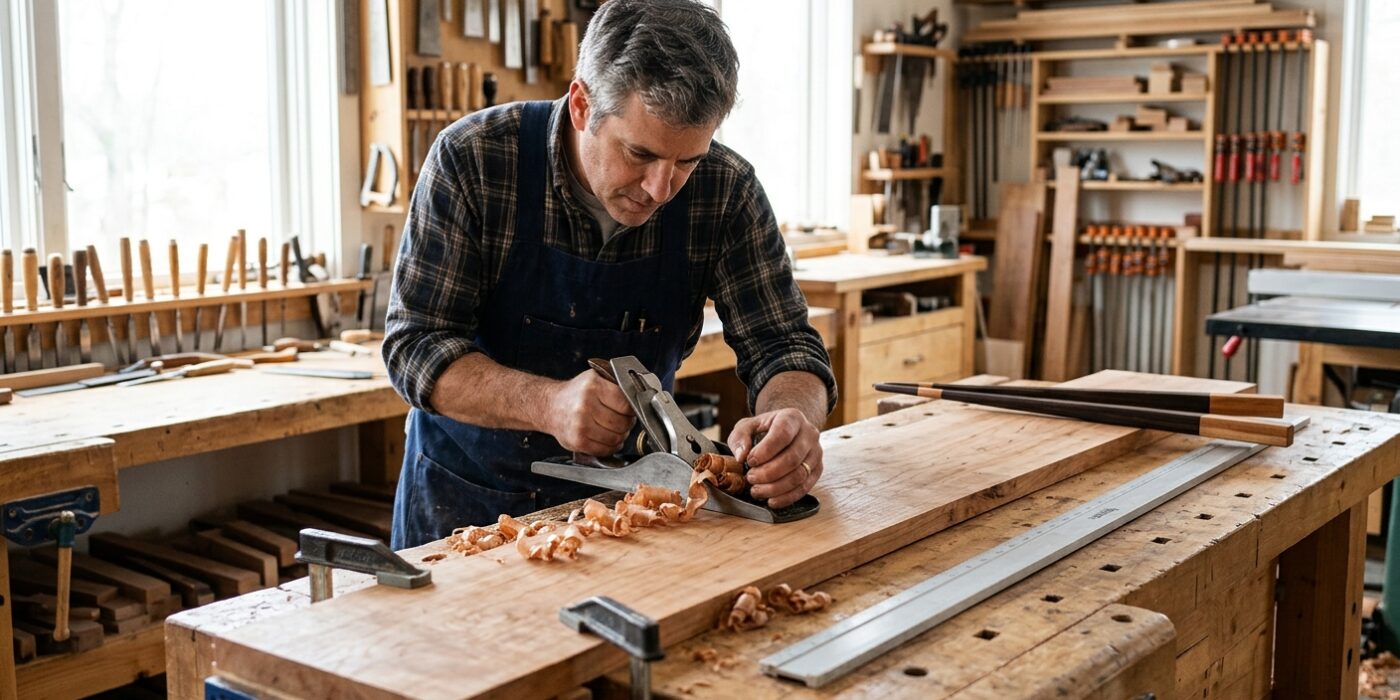
For twist: start by planing diagonally across the high corners — the corners identified by the winding sticks as high. Take light passes with a sharp hand plane (a No. 5 jack plane set for a moderately heavy shaving). Check with winding sticks frequently. Once the twist is eliminated, work the entire face with diagonal passes in both directions to level any high ridges, then finish with strokes parallel to the grain. Use winding sticks and a straight edge after every 5-10 passes to track progress.
Power Planer or Drum Sander
For bowed or cupped boards, a thickness planer removes warp efficiently but requires a flat reference face first. Shim the low corners of a cupped board with wedge shims against the planer bed so the board feeds flat. Run it through to flatten the top face, then flip and plane the second face parallel to the first. Without shimming, the planer simply follows the existing warp and the board comes out thinner but still warped.
Router Sled for Very Warped Boards
A simple router sled — two parallel rails and a crossbar with a router — flattens severely warped boards that are too twisted or bowed for a planer. The router rides the rails (which are themselves flat) and takes off high spots. This requires building the sled (a 30-minute shop project) but then handles any degree of warp. It is the best method for wide glued panels and very large slabs.
Preventing Warp
- Store wood flat, supported at both ends and in the middle, with stickers (1-inch spacers) between layers for air circulation.
- Finish all faces of a board — top, bottom, and ends — when applying a finish. Finishing only one face causes uneven moisture exchange and eventual cupping.
- Acclimate lumber to your shop’s humidity for at least 1-2 weeks before using it in projects.
Frequently Asked Questions
Can I use a warped board without fixing it?
For some applications, yes. A bowed board used as a shelf with supports at both ends and a middle support may never show the bow in use. A slightly cupped floorboard gets flattened by fasteners and adjacent boards. But in furniture where flat matters — tabletops, cabinet doors, drawer fronts — warp must be removed before the piece is built, because it only gets worse after the wood is cut to final size.
How much material will I lose flattening a warped board?
You remove material equal to the height of the highest point of warp. A board with 1/4-inch cup will lose at least 1/4 inch of thickness. Plan for this when selecting lumber — if your project needs 3/4-inch finished thickness and your board has 1/4-inch cup, buy lumber at 1-inch (5/4) thickness to allow for flattening.