Project Shopping List
A French drain is a gravel-filled trench containing a perforated pipe that collects groundwater and surface runoff and directs it away from problem areas — wet basements, flooded lawn sections, and standing water near foundations. It is the most effective solution for chronic drainage problems that surface grading alone cannot fix. A properly installed French drain lasts 20-30 years without maintenance.
What You Need
- Perforated corrugated drain pipe (4-inch diameter)
- 3/4-inch washed crushed stone (drainage gravel)
- Landscape fabric (sock or flat sheeting)
- Shovel or rented trenching machine
- Level or laser level
- Wheelbarrow
- Outlet: pop-up emitter, daylight outlet, or dry well
Understanding How a French Drain Works
Water in the soil follows the path of least resistance. A French drain creates a permeable zone (gravel) that water flows into from the surrounding soil. The perforated pipe inside the gravel collects this water and carries it by gravity to a safe outlet location. The drain must slope consistently — at least 1/8 inch per foot — so water flows toward the outlet and does not back up in the pipe. Without consistent slope, sections of the drain become dead ends and lose effectiveness.
Step-by-Step Instructions
Step 1: Plan the Route and Outlet
Map the drain path from the problem area to the outlet location. The outlet can be: a daylight exit (pipe emerges above grade at a low point, such as a slope), a pop-up emitter in the lawn (opens under water pressure, closes when dry), or a dry well (large gravel-filled pit that allows water to infiltrate). The outlet must be lower than the inlet by at least 1 inch per 8 linear feet. Measure the elevation change along the planned route with a level and string line before digging.
Step 2: Call 811 and Obtain Permits
Call 811 (Dig Safe in the US) at least 3 business days before digging. Utility lines are often buried at drain trench depth. French drains near property lines may require a permit in some jurisdictions, particularly if the outlet directs water toward a neighboring property or public right-of-way. Check locally.
Step 3: Dig the Trench
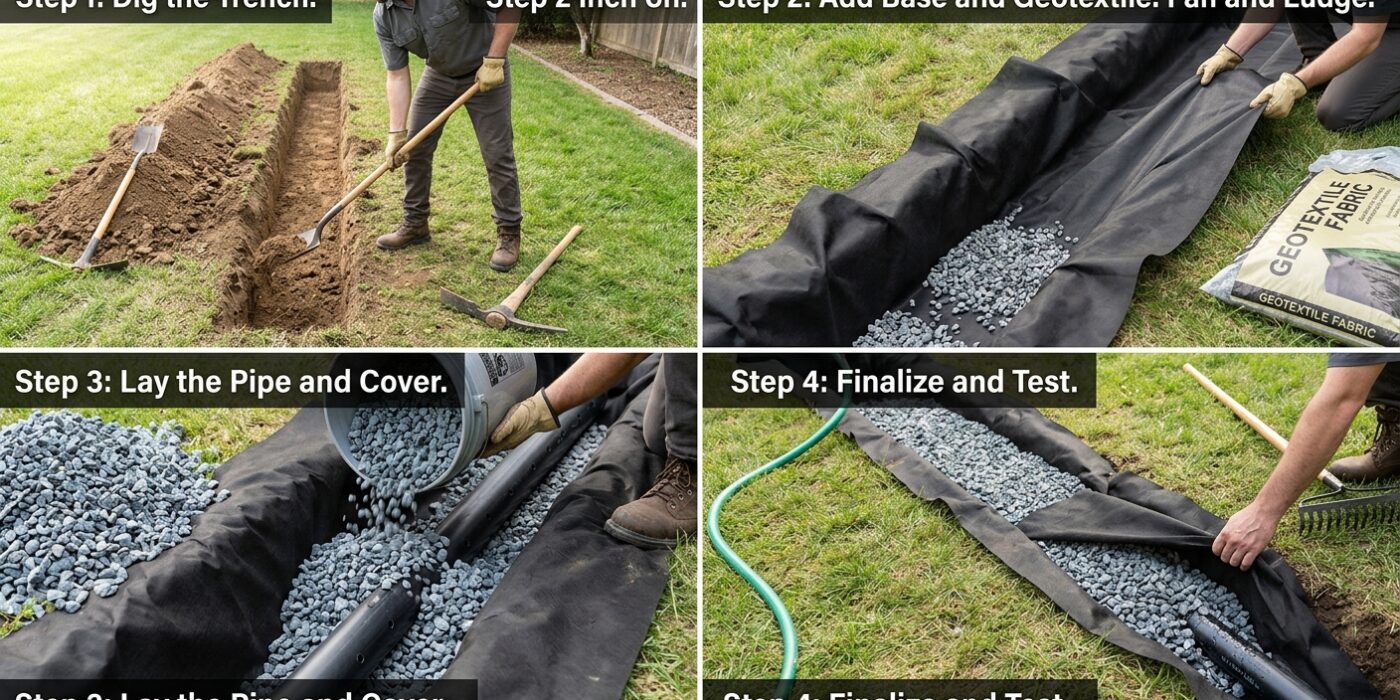
Dig the trench 12 inches wide and 18-24 inches deep. The trench must slope consistently at minimum 1/8 inch per foot toward the outlet — confirm slope with a level and tape measure at multiple points. A rental trenching machine makes this dramatically faster than hand digging for runs over 30 feet. The trench bottom must be smooth and consistent — low spots in the trench bottom create ponding in the pipe and reduce effectiveness.
Step 4: Line the Trench with Landscape Fabric
Line the trench with landscape fabric, overlapping the sides by at least 12 inches so the fabric can be folded over the top of the gravel after filling. The fabric prevents soil from migrating into the gravel and clogging the drain over time. Using drain pipe with a sock filter around it (pre-wrapped perforated pipe) provides additional protection. Do not skip this step — the most common cause of French drain failure after 5-10 years is soil clogging the gravel.
Step 5: Add Gravel Base and Lay the Pipe
Pour 3-4 inches of 3/4-inch washed crushed stone into the bottom of the trench. Lay the perforated pipe on the gravel with the perforations facing down (not up) — this allows water to enter from below where the water table is highest, rather than collecting surface runoff from above. Connect pipe sections with couplings. At the outlet end, connect to the pop-up emitter or form the daylight outlet. Confirm the pipe slopes continuously toward the outlet.
Step 6: Fill with Gravel and Close
Fill the trench with gravel to within 3-4 inches of the surface, covering the pipe completely. Fold the landscape fabric over the top of the gravel and overlap seams. Add topsoil and sod, or decorative stone, over the fabric to the finished grade. Mark the pipe location with a stake or plan for future reference — if the drain ever needs inspection or cleanout, knowing where the pipe runs is essential.
Pro Tips
- Use washed gravel — unwashed gravel contains fines (small particles) that migrate into the fabric and clog the drain much faster than washed stone.
- For very long drains (over 100 feet), install a cleanout at mid-point — a vertical pipe with a cap at grade that allows you to flush the drain with a hose if it ever becomes sluggish.
Frequently Asked Questions
How deep should a French drain be?
For intercepting surface runoff before it reaches a foundation: 18-24 inches deep is adequate. For intercepting a high water table that is causing basement moisture: the drain must be at or below the elevation of the basement floor slab, which may require 4-6 feet of depth and an interior drain system rather than an exterior one.
Can a French drain outlet into a neighbor’s yard?
No. Directing water from your property onto an adjacent property creates legal liability and is prohibited in most jurisdictions. The outlet must discharge to your own property, a public right-of-way at a designated drainage point, or a municipal storm drain with appropriate permits.